
- 02/06/2026
- Dr. Rupali Bandgar
- 0 Comments
- Blogs
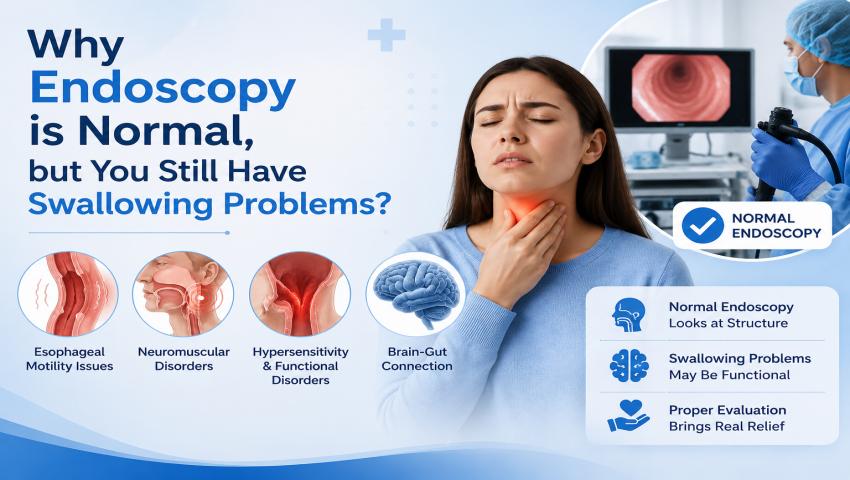
Why Endoscopy is Normal, but You Still Have Swallowing Problems?
Yes - "Your endoscopy is completely normal."
You heard those words from your doctor. But every meal still feels like a struggle. You have difficulty swallowing even soft foods. Sometimes there is pain while swallowing. Other times, food feels like it is stuck halfway down your throat. If this sounds familiar, you are not alone.
A normal endoscopy does not always mean nothing is wrong. It simply means the inner lining of your food pipe looks healthy to the naked eye. But swallowing is a complex process. It involves muscles, nerves, and precise coordination — none of which a standard endoscopy can fully assess.
In this blog, Dr. Rupali Bandgar-Jankar — Pune’s first Consultant Gastrophysiologist — explains why swallowing problems persist even after a normal endoscopy, and what you should do next.
What Does a Normal Endoscopy Actually Mean?
An endoscopy is a camera test. The doctor passes a thin flexible tube through your mouth to look at the lining of your oesophagus (food pipe), stomach, and the first part of your small intestine.
It is very good at detecting:
- Ulcers and erosions
- Tumours or growths
- Visible inflammation or bleeding
- Structural blockages
But here is the key point — endoscopy only sees the surface. It cannot check:
- How well your oesophagus muscles are working
- Whether your food pipe is contracting correctly
- Nerve-related problems in the gut
- Microscopic tissue changes are invisible to the camera
So when your endoscopy is normal, it rules out structural problems. It does not rule out functional or motility disorders, which are among the most common causes of persistent difficulty swallowing. According to Dr. Rupali Bandgar-Jankar, many patients spend months or even years being told “everything is normal” — when in fact, a deeper functional assessment would reveal the real problem.
Common Causes of Swallowing Problems With a Normal Endoscopy:
- Eosinophilic Oesophagitis (EoE): EoE is an allergic condition where white blood cells (eosinophils) build up in the lining of the food pipe. It causes pain during swallowing and food getting stuck, especially dry or solid foods. The food pipe can look completely normal on camera. EoE is only confirmed through biopsy — a small tissue sample taken during endoscopy. Many patients go years without a diagnosis because biopsies are not always taken routinely.
- Achalasia: Achalasia is a motility disorder. The lower end of the oesophagus does not relax properly when you swallow. Food and liquid cannot pass into the stomach easily. Patients often describe a feeling of food being stuck in the chest. They may regurgitate undigested food at night. Endoscopy appears normal in early achalasia — only specialised pressure tests can detect it.
- Oesophageal Spasm: The oesophagus is a muscular tube. In some people, it contracts in an uncoordinated or overly forceful way. This causes sudden pain while swallowing — sometimes sharp enough to be mistaken for a heart attack. The endoscopy looks perfectly normal. The spasm happens between meals, so the camera never catches it.
- GERD With Atypical Symptoms: Most people know GERD (acid reflux) causes heartburn. But in some patients — especially Indians — GERD presents differently. They feel sore throat pain while swallowing, a constant urge to clear the throat, or a burning sensation in the chest without typical heartburn. The acid damage can be microscopic and invisible during endoscopy. Only a pH study can confirm it.
- Functional Dysphagia: This is a gut-brain connection disorder. The oesophagus is physically and structurally normal. But the brain’s signals to the gut are dysregulated. The patient genuinely feels pain during swallowing or difficulty moving food down, without any visible cause. It is real. It is not “in your head.” And as Dr. Rupali Bandgar-Jankar explains, functional dysphagia responds very well to the right treatment when diagnosed correctly.
- Globus Sensation: Globus is the persistent feeling of a lump or tightness in the throat — even when there is nothing physically there. It makes swallowing feel uncomfortable and sometimes sore to swallow.
Stress and anxiety often trigger or worsen globus. Endoscopy is always normal. But the sensation can significantly affect quality of life.
What Tests Are Needed When Endoscopy is Normal?
If your endoscopy is normal but swallowing problems continue, your doctor should consider:
- High-Resolution Oesophageal Manometry This is the gold standard test for swallowing disorders. A thin tube is passed into the food pipe to measure muscle pressure and coordination during swallowing. It detects achalasia, spasm, and other motility disorders.
- Barium Swallow X-Ray You swallow a barium liquid, and real-time X-rays capture how it moves through your food pipe. It reveals movement patterns that a standard camera cannot.
- pH Impedance Study: A 24-hour test that records acid and non-acid reflux. This is crucial when GERD is suspected but not visible on endoscopy.
- Oesophageal Biopsy. Even if the oesophagus looks normal, biopsies should be taken to rule out EoE. Many patients only get a diagnosis after a proper biopsy is requested.
This is exactly where Dr. Rupali Bandgar-Jankar makes a real difference. As a trained Gastrophysiologist, she specialises not just in the structure of the gut, but in how it functions — using advanced tests that most general gastro clinics do not offer.
How Are These Conditions Treated?
Each condition has a specific treatment approach:
- Eosinophilic Oesophagitis — Dietary elimination (removing trigger foods like dairy, wheat, or eggs), swallowed steroid sprays, and proton pump inhibitors to reduce inflammation.
- Achalasia — Depending on severity, pneumatic balloon dilation, the POEM (Per-Oral Endoscopic Myotomy) procedure, or laparoscopic surgery. All aim to relax the lower oesophageal sphincter.
- Oesophageal Spasm — Smooth muscle relaxants, calcium channel blockers, or Botox injection into the oesophageal muscle to reduce abnormal contractions.
- Functional Dysphagia — Gut-brain therapy, low-dose neuromodulators, cognitive behavioural therapy, and dietary adjustments.
- GERD-Related Swallowing Issues — Acid suppression therapy, strict dietary changes, positional adjustments, and, in some cases, endoscopic anti-reflux procedures.
Dr. Rupali Bandgar-Jankar creates a personalised treatment plan for each patient based on their specific test results — not a one-size-fits-all approach.
When Should Swallowing Problems Be Taken Seriously?
Not every swallowing issue is dangerous. But some symptoms need urgent attention. See a specialist immediately if you notice:
- Food or liquid getting stuck in your chest or throat regularly
- Unexplained weight loss alongside difficulty swallowing
- Choking or coughing fits during or after meals
- Sore to swallow even with liquids
- Worsening sore throat pain while swallowing over weeks
- Hoarseness or a change in voice
These can be signs of more serious conditions. Do not wait. A proper diagnosis from a qualified specialist is essential.
Still Struggling to Swallow? Get the Right Diagnosis Today:
A normal endoscopy is a good starting point — not a final answer.
If you are still dealing with difficulty swallowing, pain while swallowing, or a persistent sore throat pain while swallowing, your body is telling you something is not right.
Dr. Rupali Bandgar-Jankar is Pune’s first Consultant Gastrophysiologist and Biofeedback Specialist.
With over 8 years of experience, she is widely regarded as the best Gastrophysiologist in Pune for patients whose symptoms have gone unexplained after routine investigations. She uses advanced gastro physiological methods — including high-resolution manometry and biofeedback therapy — that are simply not available at most general gastro clinics. If you have been told your endoscopy is normal but your symptoms say otherwise, Dr. Rupali Bandgar-Jankar is the specialist you need.
Book your consultation online.
Do not let unexplained swallowing problems take over your life. Take the first step towards the right diagnosis — today.
Frequently Asked Questions:
Yes. Anxiety and stress are directly linked to globus sensation and functional dysphagia. The gut and brain communicate constantly. High stress can disrupt muscle coordination in the oesophagus and create a real sense of pain during swallowing — even without any physical damage.
In most cases, a normal endoscopy is reassuring. But dysphagia with weight loss, choking, or food completely blocking the throat needs immediate investigation. Never ignore progressive symptoms.
Ask your doctor for oesophageal manometry and a pH impedance study. If not already done, request biopsies for EoE. Consider consulting a Gastrophysiologist — a specialist trained in gut function, not just gut structure.
Absolutely. EoE can be completely invisible on camera. The food pipe looks normal in many EoE patients. A biopsy is the only way to confirm it. This is why routine biopsies are recommended even when the scope looks normal.