
- 21/05/2026
- Dr. Rupali Bandgar
- 0 Comments
- Blogs
Chronic Constipation vs Motility Disorder – What’s the Difference?
You’ve been struggling for months. You’ve added more fiber to your plate, you’re drinking gallons of water, and you’ve tried every laxative on the pharmacy shelf—yet the relief never lasts.
When a doctor mentions a “motility disorder,” it’s easy to feel confused. Is that just a fancy word for constipation, or is it something else entirely? According to Dr. Rupali Bandgar-Jankar, Consultant Gastrophysiologist at Kaizen Gastro Care, Pune, understanding this distinction is the “missing link” for many patients who have suffered for years without the right treatment.
What is Chronic Constipation?
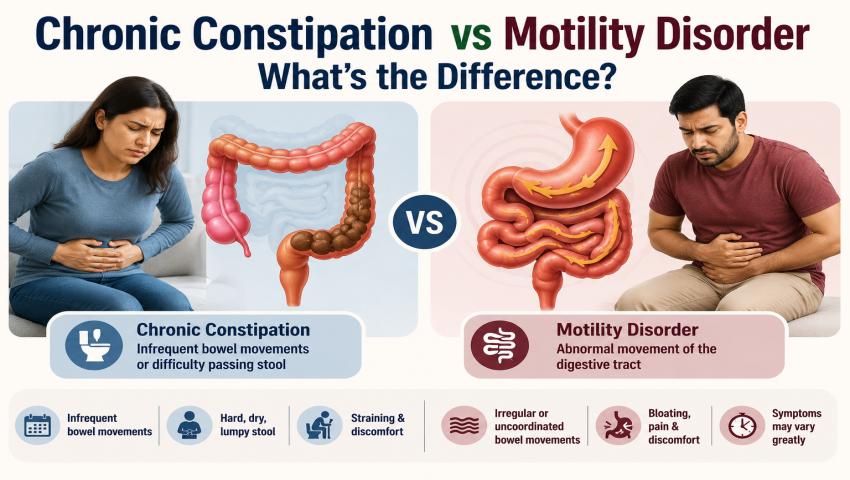
Chronic constipation is more than just a “clogged” feeling. It is medically defined as having two or more of the following symptoms for at least three months:
- Infrequent Movements: Fewer than three bowel movements per week.
- Difficult Texture: Hard, lumpy, or dry stools.
- Straining: Significant effort required during more than 25% of bathroom visits.
- Incomplete Emptying: A persistent feeling that you haven’t fully “finished.”
- Manual Assistance: Needing to use fingers or physical pressure to pass stool.
Common Lifestyle Causes:
Most “standard” constipation (often called functional constipation) is caused by:
- A low-fiber diet and poor hydration.
- A sedentary lifestyle.
- Certain medications (antidepressants, iron tablets, or painkillers).
- Underlying conditions like diabetes or hypothyroidism.
What is a GI Motility Disorder?
While constipation is a symptom, a motility disorder is a mechanical or electrical failure in your gut. Your digestive tract relies on a coordinated “wave” of muscle contractions (motility) to move waste along. When the nerves or muscles in the gut don’t communicate correctly, things grind to a halt.
Common motility disorders often mistaken for simple constipation include:
- Slow Transit Constipation (STC): The colon moves waste at a snail’s pace due to nerve dysfunction.
- Dyssynergic Defecation: This is a coordination problem. Instead of relaxing to let stool pass, your pelvic floor muscles accidentally tighten, creating a physical “wall.”
- Colonic Inertia: A severe condition where the colon effectively stops functioning.
The Key Difference: Chronic Constipation vs. Motility Disorder
Think of it this way: Constipation is like a fever, while a motility disorder is the infection causing it.
If you only take laxatives, you are treating the “fever” (the symptom) without addressing the “infection” (the nerve/muscle dysfunction). This is why lifestyle changes alone often fail for motility patients.
Red Flags: When to See a Specialist?
- Laxatives have stopped working or provide only temporary relief.
- You feel a physical blockage in the rectum even when straining.
- You suffer from persistent, severe bloating.
- You have developed recurring piles (hemorrhoids) or anal fissures.
- You've experienced unexplained weight loss along with bowel changes.
Beyond the Colonoscopy: How Diagnosis Works?
A standard colonoscopy looks at the structure of your gut (checking for polyps or tumors), but it cannot see how the gut functions. To find a motility disorder, Dr. Rupali Bandgar-Jankar uses specialized GI physiology tests:
- Anorectal Manometry: Measures the pressure and coordination of the anal sphincter and pelvic floor muscles.
- Balloon Expulsion Test (BET): A simple test to see if the pelvic floor muscles relax correctly during a bowel movement.
- Colon Transit Study: Tracking how quickly material moves through your system using specialized markers and X-rays.
Treatment: Finding Lasting Relief:
The treatment path depends entirely on the diagnosis:
- For Lifestyle Constipation: High-fiber diets (25–30g/day), 8–10 glasses of water, and daily exercise usually solve the problem.
- For Motility Disorders (Dyssynergia): Biofeedback Therapy is the gold standard. It’s a non-surgical, painless process where patients use computer-guided sensors to “re-train” their muscles to relax and contract correctly.
- For Slow Transit: Specialized neuromodulating medications may be used to “jumpstart” the gut’s nervous system.
Conclusion:
Chronic constipation and GI motility disorders are not the same thing — though they are closely linked. Constipation is what you feel; a motility disorder is often why you feel it. Getting this distinction right is what separates months of ineffective self-treatment from a clear diagnosis and a treatment plan that actually works.
If your constipation has not improved despite trying the usual measures, do not simply accept it as normal. You may need a motility evaluation — not another laxative.
Call: 9763635252
Book a consultation with Dr. Rupali Bandgar-Jankar at Kaizen Gastro Care, Pune.
FAQs: Chronic Constipation vs Motility
Long-term straining and bowel dysfunction can damage pelvic floor nerves and muscles over time, potentially contributing to motility problems. Early diagnosis and treatment always lead to better outcomes.
No. A colonoscopy evaluates the structure of the colon. Motility disorders affect function, which requires separate specialised tests like manometry and transit studies.
Yes. Dr. Rupali Bandgar-Jankar at Kaizen Gastro Care, Wakad, Pune, is one of the few specialists in Maharashtra offering biofeedback therapy for pelvic floor dysfunction and dyssynergic defecation.
Most patients notice improvement within 3 to 4 sessions, with a full course typically requiring 6 to 8 sessions.