
- 18/03/2026
- Dr. Rupali Bandgar
- 0 Comments
- Blogs
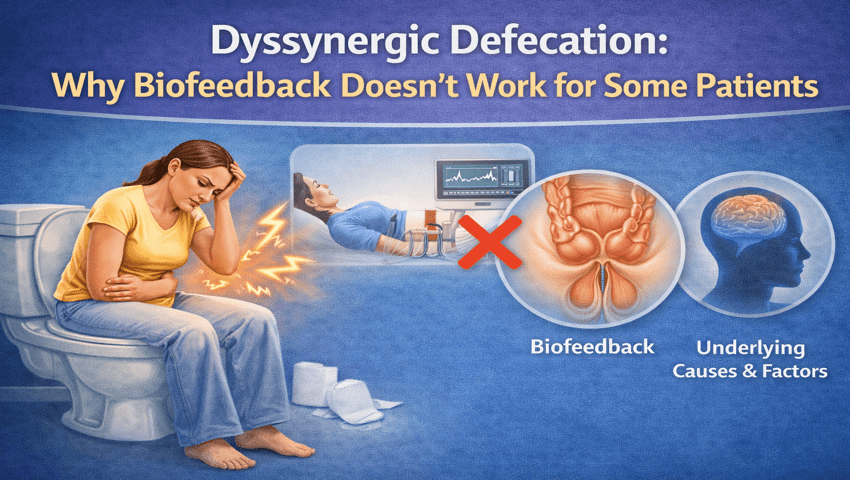
Dyssynergic Defecation: Why Biofeedback Doesn’t Work for Some Patients
Chronic constipation is more than just an occasional discomfort. For many, it is a life-altering condition that affects mental peace and daily routines. When standard laxatives fail, doctors often recommend a specialized treatment called Biofeedback Therapy in Pune.
Biofeedback is considered the “Gold Standard” for treating Dyssynergic Defecation (DD). This is a condition where the brain and pelvic floor muscles fail to coordinate. Instead of relaxing to let stool pass, the muscles tighten or fail to push effectively.
However, a common concern among patients is: “I took the therapy, but why am I not getting better?” If you are searching for a Gastrophysiologist in Pune, it is vital to understand that failure in therapy often stems from correctable factors.
Understanding Biofeedback: It’s an Exercise, Not a Pill:
Many patients expect biofeedback to work like a tablet—take it and get instant relief. In reality, Biofeedback is a retraining process. At Kaizen Gastro Care, we often use the “Gym Analogy” to explain this.
Imagine joining a gym to build muscle. If you lift weights with the wrong form, you won’t see results. You need a qualified personal trainer to correct your posture. Similarly, Biofeedback is an exercise for your pelvic muscles. If the technique is wrong, the defecation process won’t fix itself.
The therapy focuses on three main areas:
- Anal Relaxation: Learning to relax the sphincter muscles when pushing.
- Abdominal Pushing: Coordinating your breath and stomach muscles to create downward pressure.
- Sensory Perception: Training the brain to recognize when the rectum is full.
5 Reasons Why Biofeedback Therapy May Fail:
If you haven’t seen results, it might be due to one of the following reasons:
- Anorectal Manometry vs. Surface EMG: There are two ways to perform biofeedback. Some clinics use surface sensors (EMG) placed outside the body. However, Manometry-based Biofeedback is much more effective. It uses internal sensors to provide a precise map of how your muscles contract and relax. At Kaizen Gastro Care, we prioritize manometry-based sessions for better accuracy.
- Lack of Home Practice: A clinical session lasts only 20 to 40 minutes. You cannot retrain your brain in just one hour a week. Recovery requires daily homework. If you don’t practice the relaxation techniques at home, the progress made in the clinic will be lost.
- Incorrect Diagnosis: Sometimes, the patient may not have Dyssynergic Defecation at all. Other conditions like Slow-Transit Constipation, Rectocele, or Rectal Prolapse can mimic these symptoms. If the underlying physical obstruction isn’t identified, biofeedback won’t solve the problem.
- The Mind-Gut Gap: Chronic constipation causes significant stress and anxiety. This mental frustration creates a psychological block. In some cases, patients need the support of a psychiatrist alongside a Gastrophysiologist in Pune to improve the mind-muscle connection.
- Inadequate Session Length: Retraining the body takes time. Success usually requires at least 5 to 6 sessions spread over 1.5 to 2 months. Stopping therapy after just one or two sessions is a major reason for perceived failure.
How to Ensure Success: The Multi-Disciplinary Approach?
At Kaizen Gastro Care, we believe in a holistic approach to gut health. As a leading center for Biofeedback Therapy in Pune, we combine advanced diagnostics with lifestyle changes.
The Role of a Gastrophysiologist in Pune: A specialist like Dr. Rupali Bandgar-Jankar uses advanced GI motility studies to tailor the therapy. By using Oesophageal Manometry, Anal Manometry, and Balloon Expulsion Tests, she identifies the exact point of failure in the digestive process.
Supportive Measures for Success:
- Diaphragmatic Breathing: Proper breathing supports the diaphragm, which helps in pushing stool naturally.
- Mindful Defecation: Avoid using mobile phones or reading in the toilet. Focus entirely on the bodily process.
- Temporary Laxatives: We may use specific medications to keep stool soft while your muscles are still learning to relax.
What if Biofeedback Truly Fails?
If a patient completes the full course of Biofeedback and still sees no improvement, we look at alternative options:
- Botox Injections: Injecting Botox into the pelvic floor muscles can help them relax if they are chronically tight.
- A Warning on Surgery: Surgery for constipation should be the absolute last resort. In many cases, surgery can make symptoms worse if the muscle coordination (dyssynergia) isn’t fixed first.
Conclusion:
Dyssynergic Defecation is a complex “brain-gut” coordination issue, not a simple blockage. If your treatment hasn’t worked, it is often due to an incomplete diagnosis or improper technique rather than the therapy itself. Success requires the right technology, like Manometry-based Biofeedback, and the guidance of an expert Gastrophysiologist in Pune to retrain your muscles effectively. At Kaizen Gastro Care, we bridge this gap by providing personalized, research-backed protocols that help you regain control over your digestive health.
Learn more about our specialized Biofeedback Therapy services here. Don’t give up on your gut health. Consult Dr. Rupali Bandgar-Jankar for a comprehensive motility evaluation today.
Frequently Asked Questions (FAQ's):
Typically, 5 to 6 sessions over a period of 6–8 weeks are necessary for effective brain-muscle retraining.
You must practice the exercises at home daily. However, the initial training requires specialized equipment and a specialist to ensure you are using the correct muscles.
It is a cost-effective, non-surgical alternative to lifelong medication or expensive surgeries. Contact a Gastrophysiologist in Pune for a specific plan.