
- 27/03/2026
- Dr. Rupali Bandgar
- 0 Comments
- Blogs
Can Biofeedback Therapy Help in IBS with Constipation (IBS-C)?
If you are struggling with persistent bloating and the frustration of incomplete bowel movements, you are not alone. Finding a reliable Gastrophysiologist in Pune can be the first step toward relief.
Dr. Rupali Bandgar-Jankar is India’s first leading Consultant Gastrophysiologist and Biofeedback Specialist, with over 8 years of expertise in treating complex digestive and pelvic floor disorders. As the Head of the GI Motility Department at Kaizen Gastro Care in Pune, she specializes in advanced diagnostics like Anorectal Manometry and non-invasive Biofeedback Therapy for constipation in Pune. Her specialized training makes her highly experienced in providing advanced Biofeedback Therapy in Pune for patients who haven’t found relief through standard treatments.
Can Biofeedback Therapy Really Help in IBS-C?
Yes — biofeedback therapy for IBS-C has shown excellent results, especially in patients where constipation is caused by poor muscle coordination rather than just diet or lifestyle.
In many IBS-C cases, the issue is not just in the gut but in how the pelvic floor muscles function. Biofeedback for IBS-C helps retrain these muscles, making bowel movements easier and more natural.
What Is IBS with Constipation (IBS-C)? Symptoms, Causes & Diagnosis
To understand the treatment, we must first look at the condition. What is IBS? The IBS full form in medical terms is Irritable Bowel Syndrome. It is a functional gastrointestinal disorder that affects how your digestive system works.
IBS meaning often involves a combination of abdominal pain and changed bowel habits. Specifically, IBS-C is the subtype where constipation is the primary issue. Common signs symptoms irritable bowel syndrome include:
- Hard or lumpy stools.
- Straining during bowel movements.
- Abdominal bloating and gas.
- A feeling that you cannot fully empty your bowels.
Many patients ask, “is IBS dangerous?” While it is not life-threatening or cancerous, it can significantly decrease your quality of life, leading to anxiety and social withdrawal if left untreated.
What Is Biofeedback Therapy?
If you are new to this concept, you might wonder about the biofeedback definition. Essentially, the biofeedback meaning is using electronic monitoring to help a patient learn to control a bodily function that is usually involuntary.
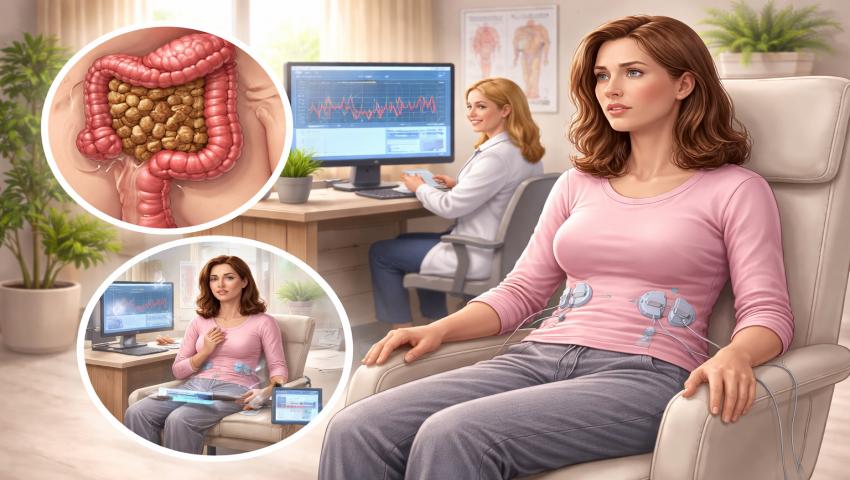
In a clinical sense, what is biofeedback for the gut? It is a painless, non-surgical process where sensors provide real-time data about your muscle activity. By seeing this data on a screen, you learn how to relax and contract the correct muscles to pass stool easily. A simple biofeedback def would be: “Learning to control your body’s signals to improve your health.”
How Does Biofeedback Therapy Help in IBS-C?
In many IBS-C cases, patients suffer from “dyssynergic defecation.” This means when they try to go to the bathroom, their pelvic floor muscles tighten instead of relaxing. Biofeedback therapy for ibs-c acts like a “muscle coach.” It shows the patient exactly what their muscles are doing, allowing them to correct the coordination between the diaphragm and the anal sphincter.
How Biofeedback Improves Bowel Function in IBS-C Patients:
Irritable bowel syndrome biofeedback works by focusing on three main areas:
- Sensory Training: Helping the rectum become more sensitive to the presence of stool.
- Coordination: Teaching the abdominal muscles to push while the pelvic floor relaxes.
- Consistency: Retraining the body to follow a natural, daily rhythm without straining.
Who Should Consider Biofeedback Therapy for IBS with Constipation?
You should consider biofeedback ibs treatment if:
- Laxatives and fiber supplements have failed to work.
- You feel a “blockage” when trying to pass stool.
- Tests like Anorectal Manometry show your muscles are not coordinating correctly.
- You want a drug-free, non-invasive treatment option.
Benefits of Biofeedback Therapy for IBS-C (Beyond Medications):
Unlike pills that only soften the stool, biofeedback solves the mechanical issue.
- No Side Effects: It is entirely non-invasive.
- Long-lasting: Once you learn the technique, the benefits stay with you.
- Empowerment: It gives the patient control over their own bodily functions.
Biofeedback vs Medications for IBS-C: Which Works Better?
While medications provide quick relief for some, they often stop working over time or cause dependency. Studies show that for functional constipation and IBS-C, biofeedback is often more effective than standard laxatives because it fixes the underlying muscle dysfunction rather than just masking the symptoms.
How Dr. Rupali Bandgar-Jankar Treats IBS-C Effectively?
At Kaizen Gastro Care, Dr. Rupali Bandgar-Jankar uses a personalized approach. She starts with a detailed diagnostic workup to ensure the patient is a right fit for the therapy. By Combining her vast experience in GI physiology with ultra-modern facilities, Dr. Rupali Bandgar-Jankar ensures that each session is tailored to the patient’s specific muscle patterns. Under the guidance of Dr. Rupali Bandgar-Jankar, patients often see a significant reduction in bloating and straining within just a few sessions.
Conclusion:
IBS-C doesn’t have to be a life sentence of discomfort. With the right expert guidance, you can retrain your body and regain your confidence. Dr. Rupali Bandgar-Jankar and her team are dedicated to helping you achieve better digestive health through advanced, non-surgical methods.
Ready to find relief? Schedule a consultation with Dr. Rupali Bandgar-Jankar at Kaizen Gastro Care today or Contact us at 9763635252 Now